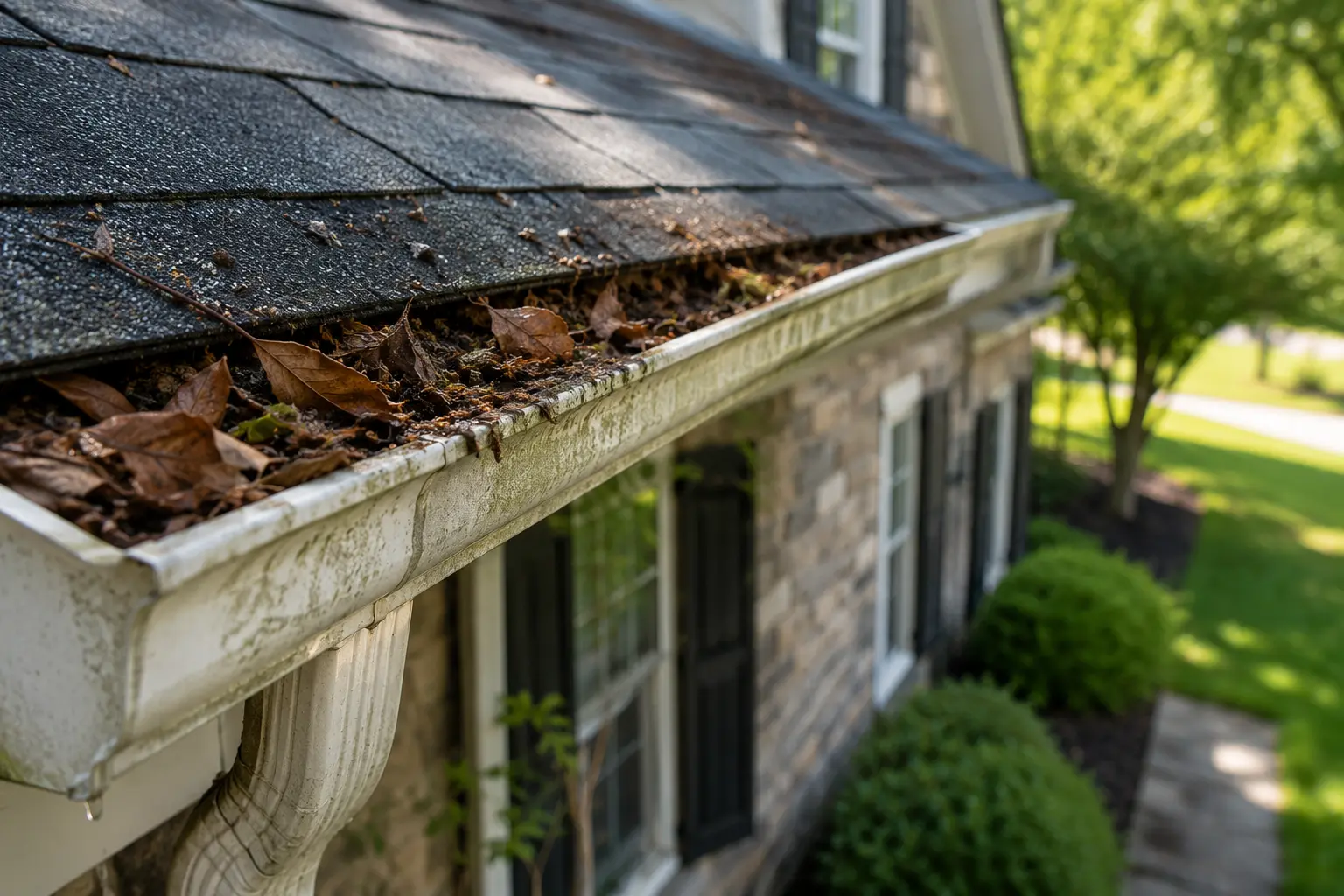
Your gutters aren’t just catching rainwater. They’re catching evidence — evidence of what’s really happening on your roof. Most Bucks County homeowners clean their gutters once or twice a year, toss whatever’s in there, and move on. What they don’t realize is that what’s sitting in those gutters right now is one of the most reliable early warning systems for roof problems you’ll ever get.
I’m Darin Martin, owner of Martin Roofing & Construction Inc. In our 16 years serving Bucks County homeowners, we’ve diagnosed hundreds of roof problems that started with a simple gutter inspection. Your gutters collect and display the debris your roof is shedding — and once you know what to look for, they’ll tell you exactly what’s going on up there before the damage becomes serious. Here’s what Bucks County homeowners should be watching for this summer.
What You’ll Learn
- Why your gutters are a diagnostic tool for your roof’s health
- The 6 warning signs hiding in your gutters right now
- How damaged gutters create additional roof problems
- What to do right now
- Why Bucks County homeowners choose Martin Roofing & Construction Inc.
- Frequently asked questions
- Next steps
Why Your Gutters Tell the Real Story
Your roof sheds material constantly. It’s a natural part of aging — granules wash off, sealant breaks down, organic debris collects, and water carries it all into your gutter system. Over the course of a Bucks County summer, your gutters accumulate a sample of everything your roof is going through.
The difference between a healthy roof and a failing one often shows up in the gutters months before it shows up as a leak, a stain, or a visible problem from the ground. That makes a five-minute gutter check one of the smartest things a Bucks County homeowner can do every summer — especially after a storm.
In our 16 years serving Bucks County homeowners, we’ve learned that the gutters never lie. Here’s what to look for.
The 6 Warning Signs Hiding in Your Gutters
1. Heavy Granule Deposits
What you’re seeing: Dark, coarse, sand-like particles collecting in your gutters or forming small piles at the bottom of your downspouts.
What it means: Those granules are the protective coating on your asphalt shingles. Every shingle has a layer of ceramic-coated granules that serve two critical purposes — they protect the asphalt from UV damage and they reflect heat away from your roof. When they wash off, both protections go with them.
When it’s serious: A light dusting of granules is normal, especially on a newer roof that’s still shedding excess from manufacturing. But if you’re seeing heavy deposits — handfuls, not pinches — after every summer storm, your shingles are deteriorating faster than they should. On Bucks County roofs 15+ years old, heavy granule loss usually means the shingles are approaching the end of their service life.
What most people miss: Heavy granule loss after a hailstorm is especially significant. Hail physically knocks granules off the surface, leaving exposed asphalt that breaks down fast in Bucks County’s summer sun. If you see a dramatic increase in granule deposits after a storm, schedule an inspection.
2. Shingle Pieces or Fragments
What you’re seeing: Small pieces of shingle material — broken corners, torn edges, or crumbled fragments — mixed in with leaves and debris.
What it means: Shingles are breaking apart. This goes beyond normal wear and indicates that the asphalt binder has dried out and become brittle. Pieces break off during wind events, thermal cycling, or even heavy rain impact.
When it’s serious: Finding any shingle fragments in your gutters is a sign of advanced deterioration. We see this most often on Bucks County homes with roofs over 20 years old, or on roofs with poor attic ventilation where heat has been baking the shingles from below for years. If fragments are showing up, your roof is past the repair stage — it’s a replacement conversation.
3. Rust-Colored or Dark Staining on Gutter Interior
What you’re seeing: Orange, rust-colored streaks or dark staining along the inside walls of your gutters, or discolored water draining from your downspouts.
What it means: Rust staining usually indicates that metal components on your roof — flashing, drip edge, or fasteners — are corroding. Dark staining can also come from algae growth on your shingles, which washes into the gutter system during rain.
When it’s serious: Corroding flashing is a leak waiting to happen. Metal flashing around chimneys, vents, and skylights is one of the most common failure points on any Bucks County roof. If your gutters are showing rust staining, the source needs to be identified and addressed — before that corroded flashing lets water into your decking during the next storm.
4. Standing Water or Sagging Sections
What you’re seeing: Water pooling in sections of your gutter that should be draining. Gutters pulling away from the fascia. Visible sagging or bowing between hangers.
What it means: Your gutter system is either clogged, improperly pitched, or the hangers and fascia behind them are failing. Standing water adds significant weight — water weighs over 8 pounds per gallon — which accelerates sagging and can pull gutters completely off the house.
When it’s serious: Standing water in gutters isn’t just a gutter problem — it’s a roof problem. When gutters overflow, water cascades directly against your fascia, soffits, and foundation. In Bucks County’s heavy summer thunderstorms, overflowing gutters can dump hundreds of gallons of water exactly where you don’t want it. If your gutters sag or hold standing water, the damage extends beyond the gutter itself.
5. Seed Pods, Organic Buildup, or Plant Growth
What you’re seeing: Thick mats of decomposed leaves, seed pods, or actual plants and weeds growing out of your gutters.
What it means: Your gutters are clogged and have been for a while. The organic material has decomposed enough to form a growing medium — which means water hasn’t been flowing through your gutter system properly for weeks or months.
When it’s serious: Clogged gutters in a Bucks County summer create two immediate problems. First, water backs up behind the clog and can wick under your roof’s drip edge, getting into your fascia and decking. Second, standing water in clogged gutters becomes a breeding ground for mosquitoes — a significant summer concern in Bucks County.
The bigger concern: Chronic gutter clogs are often a sign that gutter protection is needed. Martin Roofing & Construction Inc. installs gutter guard systems that prevent debris from entering the gutter while allowing water to flow freely. It’s one of the smartest upgrades a Bucks County homeowner can make.
6. Nails, Screws, or Metal Debris
What you’re seeing: Roofing nails, screws, or small metal pieces in your gutters.
What it means: Fasteners are backing out of your roof. This happens when decking expands and contracts with temperature changes, or when the decking itself is deteriorating and losing its grip on fastener threads.
When it’s serious: A single nail is a minor curiosity. Multiple nails or fasteners in your gutters is a sign that your roof’s fastening system is compromised. Each nail that backs out leaves a hole in your decking — a direct path for water. We see this on Bucks County roofs that have gone through years of freeze-thaw and thermal cycling without proper ventilation. If you’re finding hardware in your gutters, call for an inspection.
How Damaged Gutters Create Additional Roof Problems
Here’s what most homeowners don’t connect: bad gutters make roof problems worse.
When gutters clog, overflow, or pull away from the house, water doesn’t disappear — it goes where it shouldn’t. Overflowing gutters dump water against the fascia board, which rots over time and weakens the structural connection between your roof edge and the house. Water that backs up behind a clog can wick under shingle edges at the eaves, soaking the starter course and decking underneath.
In Bucks County winters, backed-up gutters are also the primary cause of ice dams — ice formations that force water under shingles and into the roof system. Fixing your gutters now, in summer, prevents the ice dam damage that shows up next March.
Gutters and roofing are connected systems. At Martin Roofing & Construction Inc., we inspect and address both — because fixing one without the other is only half the job.
What to Do Right Now
You don’t need to climb a ladder to start. Here’s a safe summer gutter check for Bucks County homeowners:
- After the next storm, walk your property and look at each downspout exit — check for granule piles
- Look up at your gutters from the ground — can you see debris piling over the edge? Any visible sagging?
- Check for water staining on your fascia boards — dark streaks below the gutter line mean overflow is happening
- Look at the ground below your gutters during a heavy rain — water should exit from downspouts, not pour over gutter edges
- Note any plants growing from your gutters — that means they’ve been clogged long enough for roots to establish
If you see two or more of these signs, it’s time for a professional gutter and roof inspection.
Why Bucks County Homeowners Choose Martin Roofing & Construction Inc.
We’ve been serving Bucks County homeowners since 2009 — Yardley, Newtown, Langhorne, New Hope, Doylestown, Warminster, Levittown, and every town in between. Here’s what makes MRC different:
- 16+ years serving Bucks County, PA — locally owned, family-run
- GAF Gold Elite Certified Contractor — top tier manufacturer certification
- Service-Disabled Veteran-Owned Small Business (SDVOSB) — VA verified
- Google Guaranteed — background checked and verified
- On-Site Project Manager on every job — Darin or Andy personally oversees your project
- 9 Google Rating — hundreds of Bucks County neighbors trust MRC
- 20-Year Workmanship Warranty + GAF Lifetime Manufacturer’s Warranty
- Gutter installation and gutter protection — complete system, not just shingles
Frequently Asked Questions
How often should I check my gutters in Bucks County?
At minimum, twice a year — once in late spring and once in late fall. Additionally, check downspout exits after any significant summer storm for granule deposits or debris backups. A quick ground-level visual check takes five minutes and can catch problems early.
What does heavy granule loss in gutters mean?
Heavy granule deposits — handfuls, not light dustings — indicate your shingles are deteriorating. On Bucks County roofs 15+ years old, this usually means the shingles are approaching the end of their service life. After a hailstorm, heavy granule loss can indicate storm damage. Either way, schedule a free inspection with Martin Roofing & Construction Inc. Call 215-696-1033.
Do you install gutter protection systems?
Yes. Martin Roofing & Construction Inc. installs gutter guard systems that prevent debris from entering the gutter while allowing water to flow freely. It’s one of the smartest upgrades for Bucks County homeowners dealing with chronic clogs from surrounding trees.
How much does gutter installation cost in Bucks County, PA?
Gutter installation in Bucks County averages around $3,000 depending on the size of your home and the type of system installed. We provide free, no-obligation estimates.
How much does roof replacement cost in Bucks County, PA?
Most residential roof replacements in Bucks County range from $8,000 to $15,000 depending on the size of your home, roof pitch, and materials selected. Our average replacement is around $12,000.
Does Martin Roofing offer financing?
Yes. We offer flexible financing through Service Financing — easy application, fast approvals, and monthly payment options that fit your budget.
Can clogged gutters really damage my roof?
Yes. Clogged gutters cause water to back up under shingle edges, rot fascia boards, and contribute to ice dams in winter. Overflow during Bucks County thunderstorms dumps water against your foundation. Gutters and roofing are connected systems — both need to function properly.
Is Martin Roofing & Construction licensed and insured in PA?
Yes. Martin Roofing & Construction Inc. holds PA License #PA116467 and is fully insured throughout the Tri-State Area. We are also Google Guaranteed and GAF Gold Elite Certified.
Next Steps
Your gutters are already showing you what’s happening on your roof — you just have to look. Here’s what to do:
- Check your downspout exits this week — granule deposits are the easiest sign to spot
- Do a ground-level gutter visual — sagging, overflow staining, or plant growth are immediate red flags
- Schedule a free roof and gutter inspection — Darin or Andy will come out personally
- Ask about gutter protection — prevent clogs before they cause damage
- Ask about financing — flexible monthly payments available for gutters and roofing
Call 215-696-1033 or request your free estimate at mrc-roofing.com. We respond promptly and serve all of Bucks County and surrounding areas. Hours: 7:00 AM – 7:00 PM, seven days a week. Free, no-obligation inspection — guaranteed.
About the Author
Darin Martin is the Owner & President of Martin Roofing & Construction Inc. With 16+ years of hands-on roofing experience in Bucks County, PA, Darin has personally overseen hundreds of residential and commercial roofing projects throughout Yardley, Newtown, Langhorne, and the surrounding areas. As a GAF Gold Elite Certified contractor and Service-Disabled Veteran, Darin brings professional-grade expertise and military-level accountability to every job.