Most Bucks County homeowners spend spring worrying about winter damage. They check for lifted shingles, look for ice dam evidence, and schedule inspections after the last freeze. What almost nobody thinks about is what happens to their roof in July and August — when the real silent damage is already underway.
I’m Darin Martin, owner of Martin Roofing & Construction Inc. In our 16 years serving Bucks County homeowners, summer heat damage is one of the most underdiagnosed problems we see — precisely because it’s invisible until it isn’t. By the time a homeowner notices something is wrong, the damage has usually been building for two or three seasons. Here’s exactly what’s happening inside your roof right now, why it matters, and what you can do about it before it turns into a costly problem.
What You’ll Learn
- How summer heat damages your roof from the inside out
- The specific damage patterns we see every summer in Bucks County
- How to tell if your roof is already being affected
- What fixes actually work — and what doesn’t
- Why Bucks County homeowners choose Martin Roofing & Construction Inc.
- Frequently asked questions
- Next steps
Why Summer in Bucks County Is Harder on Roofs Than Most Homeowners Realize
Bucks County summers are a specific combination of conditions that hit roofing systems hard: high ambient temperatures, intense direct sun, humidity that never really drops, and afternoon thunderstorms that cycle heat and moisture in ways that accelerate aging.
Here’s what most homeowners don’t know: the surface temperature of a dark asphalt shingle roof on a 90°F Bucks County afternoon routinely reaches 160°F to 180°F. That’s not air temperature — that’s the temperature of the material sitting on top of your home for six to eight hours every clear summer day.
At those temperatures, things happen to roofing systems that can’t be seen from the ground, can’t be felt inside the house, and often don’t show up as visible damage until a season or two later. Understanding what’s happening helps you get ahead of it.
The 5 Ways Summer Heat Destroys a Bucks County Roof From the Inside Out
1. Attic Heat Buildup Bakes Your Shingles From Below
This is the mechanism most Bucks County homeowners never hear about, and it’s doing the most damage.
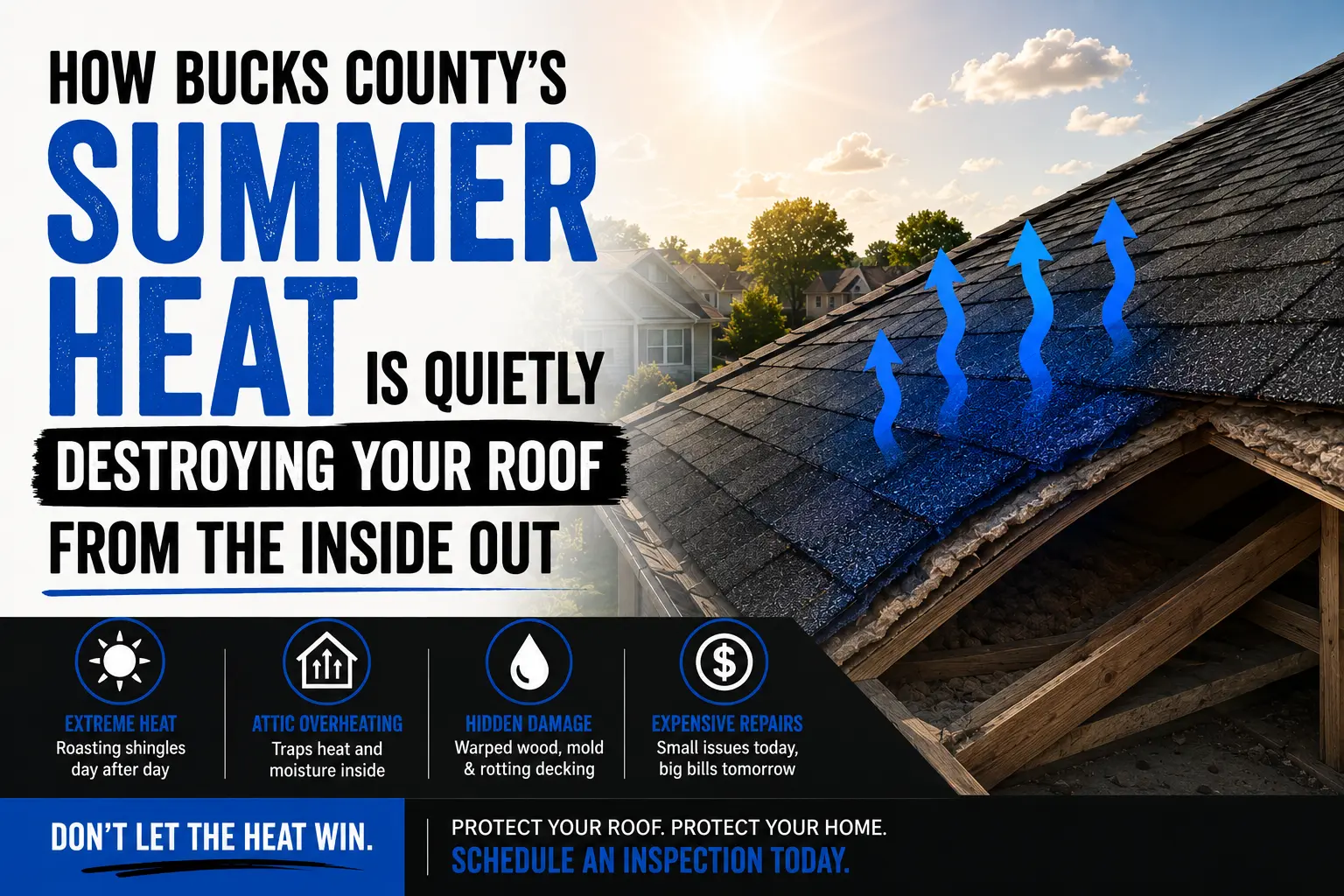
Your shingles absorb heat from the sun above. Simultaneously, a poorly ventilated attic traps superheated air below — sometimes reaching 150°F to 160°F in Bucks County summers. Your shingles are now being cooked from both directions at once.
That sustained heat breaks down the asphalt binder in your shingles — the compound that holds the granules in place and keeps the shingle flexible. When the binder breaks down, shingles become brittle, lose granules faster, and eventually crack or curl. This process happens slowly, over multiple summers, which is exactly why it’s so easy to miss.
The fix isn’t patching shingles. The fix is correcting the ventilation system so heat can escape the attic before it damages the roofing system above it. We see under-ventilated attics constantly on Bucks County homes built before 2000 — and the shingle damage that comes with them.
2. Thermal Expansion and Contraction Weakens Seals and Fasteners
Every day in a Bucks County summer, your roof goes through a dramatic temperature cycle.
Morning: roof surface at 80°F. Afternoon peak: 165–180°F. Evening after a thunderstorm: back down to 75°F. That’s a swing of nearly 100°F in a single day — and it happens repeatedly from June through September.
Every time the temperature rises, roofing materials expand. Every time it drops, they contract. Over dozens of cycles, this expansion and contraction works on the seal strips that hold shingles down, the fasteners that secure them to the decking, and the sealant around flashing and vents.
The result? Seal strips lose their adhesion. Fasteners work slightly loose. Flashing sealant cracks. None of this is immediately catastrophic — until the first major Bucks County thunderstorm tests every one of those weakened points at once. That’s when the calls start coming in.
3. Granule Loss Accelerates in Summer Heat
Your shingles’ granules serve two purposes: they protect the asphalt layer underneath from UV damage, and they reflect some of the sun’s heat. Lose the granules, and both protections go with them.
Summer heat accelerates granule loss in two ways. First, the high surface temperatures soften the asphalt binder that holds granules in place. Second, Bucks County’s summer thunderstorms — with their heavy, driving rain — physically knock loosened granules off the surface.
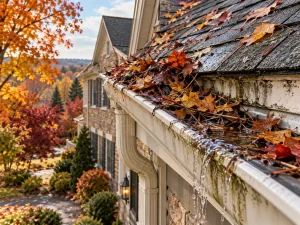
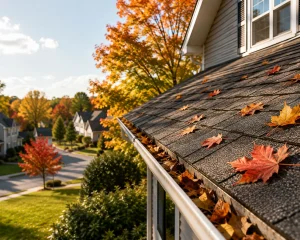
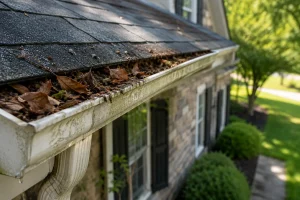
You’ll notice this in your gutters. After a summer storm, significant granule deposits in your gutters or at your downspout exits is a sign the process is well underway. A little granule loss is normal on any roof. Heavy deposits, especially from a younger roof, indicate accelerated deterioration that warrants an inspection.
Once granules are gone, UV breakdown of the asphalt layer happens fast. An area of bare asphalt on a Bucks County roof in August can become cracked and brittle within a single season.
4. Poor Attic Ventilation Creates a Moisture Trap
Here’s the part that surprises most Bucks County homeowners: summer heat damage isn’t just about heat. It’s about heat and moisture together.
Bucks County summers are humid. Relative humidity regularly runs 70–80% during the summer months. When that humid air gets into a poorly ventilated attic and can’t escape, it creates a moisture environment that sits against your roof decking and rafters for months at a time.
During the day, heat drives that moisture into the wood. At night, when temperatures drop, it condenses. Repeat that cycle for an entire Bucks County summer, and you’re looking at decking that slowly absorbs moisture, softens, and begins to degrade — often without a single raindrop ever getting through your shingles.
This is why we frequently find rotted or soft decking on Bucks County roofs that have no visible leak history. The moisture damage came from inside, driven by a ventilation system that couldn’t handle Bucks County’s summer humidity.
5. UV Degradation Compounds Every Other Problem
Ultraviolet radiation doesn’t care about temperature — it does damage on cool days too. But in Bucks County summers, UV exposure is at its annual peak, with longer days and more direct sun angles than any other season.
UV breaks down asphalt compounds at the molecular level, making shingles increasingly brittle and reducing their ability to shed water effectively. On a roof that’s already losing granules or dealing with heat-related binder breakdown, UV damage accelerates every other problem already in progress.
This is why roofs in Bucks County that look fine in early summer can show significant deterioration by September — the accumulated effect of heat, humidity, thermal cycling, and UV exposure over three months can do as much damage as two or three winters.
How to Tell If Summer Heat Is Already Affecting Your Roof
You don’t need to climb your roof to spot the signs. From the ground and from your attic:
From the ground:
- Shingles that look faded, washed out, or inconsistently colored compared to last year
- Granules collecting in gutters or at downspout exits after summer storms
- Shingle edges that appear slightly curled or raised on south- and west-facing slopes
- Visible cracking or surface texture changes on older shingles
From the attic:
- Attic feels significantly hotter than the rest of the house even with AC running
- Visible daylight around vents, ridge lines, or eave areas
- Any musty smell or moisture staining on decking or rafters
- Insulation that appears compressed or stained near the eaves
The single best indicator: Stand in your attic on a hot afternoon and assess the temperature. A properly ventilated Bucks County attic should stay within 10–20°F of outdoor air temperature. If it feels like an oven — 130°F, 140°F, or above — your ventilation system is failing and your roof is paying the price.
What Actually Fixes Summer Heat Damage
Ventilation Correction — The Real Solution
If attic heat buildup and poor ventilation are the root cause, that’s what has to be addressed. Proper ventilation for a Bucks County home means balanced intake at the soffits and exhaust at the ridge, with enough total net free area to allow hot air to escape continuously.
What doesn’t work: adding one ridge vent without adequate soffit intake. Adding a powered attic fan without fixing the underlying airflow. Patching shingles on a roof whose ventilation is actively destroying them from below.
When Martin Roofing & Construction Inc. identifies a ventilation problem during an inspection, we explain exactly what’s needed and why — because fixing ventilation without replacing shingles, or replacing shingles without fixing ventilation, is only doing half the job.
Roof Replacement With the Right System
If summer heat damage has progressed to the point where shingles are cracking, granule loss is widespread, or decking is compromised, replacement is the right call. And when we replace a Bucks County roof, we address the full system — not just the shingles.
That means proper underlayment, corrected ventilation, new flashing at every penetration, and GAF Gold Elite-certified shingles installed to manufacturer specifications. The result is a system that handles Bucks County’s summer heat the way it should — for 20–30 years.
Every replacement is backed by our 20-Year Workmanship & Labor Warranty and the GAF Lifetime Manufacturer’s Warranty on qualifying systems. Flexible financing is available through Service Financing for homeowners who want monthly payment options.
Why Bucks County Homeowners Choose Martin Roofing & Construction Inc.
We’ve been serving Bucks County homeowners since 2009 — Yardley, Newtown, Langhorne, New Hope, Doylestown, Warminster, Levittown, and every town in between. Here’s what makes MRC different:
- 16+ years serving Bucks County, PA — locally owned, family-run
- GAF Gold Elite Certified Contractor — top tier manufacturer certification
- Service-Disabled Veteran-Owned Small Business (SDVOSB) — VA verified
- Google Guaranteed — background checked and verified
- On-Site Project Manager on every job — Darin or Andy personally oversees your project
- 4.9 Google Rating — hundreds of Bucks County neighbors trust MRC
- 20-Year Workmanship Warranty + GAF Lifetime Manufacturer’s Warranty
- Financing available — flexible monthly payments through Service Financing
Frequently Asked Questions
How hot does a roof get in a Bucks County summer?
On a typical 90°F summer day, a dark asphalt shingle roof in Bucks County can reach 160°F to 180°F on the surface. Attics without proper ventilation can hit 140°F to 160°F inside. Both conditions actively damage your roofing system over time.
How do I know if my attic is properly ventilated?
Stand in your attic on a hot summer afternoon. A properly ventilated attic should stay within 10–20°F of outdoor air temperature. If it feels dramatically hotter, your ventilation is inadequate. You should also see unobstructed soffit vents at the eaves and ridge vents at the peak — both are required for proper airflow.
Can poor ventilation really cause roof damage without any leaks?
Yes. Poor ventilation causes heat and moisture damage to shingles and decking from the inside — independent of any water intrusion. We regularly find rotted decking and deteriorated shingles on Bucks County roofs with no leak history, caused entirely by ventilation failure.
How much does roof replacement cost in Bucks County, PA?
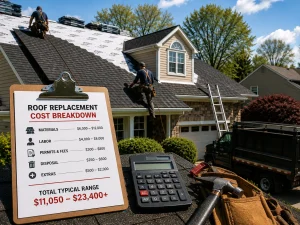
Most residential roof replacements in Bucks County range from $8,000 to $15,000 depending on the size of your home, roof pitch, and materials selected. Our average replacement is around $12,000. We provide free, no-obligation estimates.
How long does roof replacement take?
Most residential roof replacements in Bucks County are completed in a single day. We keep an on-site project manager on every job to ensure efficient, professional installation from start to finish.
Does Martin Roofing offer financing?
Yes. We offer flexible financing through Service Financing — easy application, fast approvals, and monthly payment options that fit your budget. Ask about it when you call 215-696-1033.
How do I know if I need a repair or full replacement?
If the damage is isolated and your roof is under 15 years old, a repair may be sufficient. If ventilation issues have caused widespread shingle deterioration or decking damage, or if your roof is 18+ years old, replacement is usually the smarter long-term move. Martin Roofing & Construction Inc. provides honest free inspections — we tell you exactly what you need. Call 215-696-1033.
Is Martin Roofing & Construction licensed and insured in PA?
Yes. Martin Roofing & Construction Inc. holds PA License #PA116467 and is fully insured throughout the Tri-State Area. We are also Google Guaranteed and GAF Gold Elite Certified.
Next Steps
Summer heat damage is happening right now on Bucks County roofs — most homeowners just can’t see it yet. Here’s what to do:
- Check your attic this week — temperature and moisture are the first indicators
- Look for granules in gutters — heavy deposits after summer storms are a warning sign
- Schedule a free inspection — Darin or Andy will come out personally and assess the full system
- Ask about ventilation — it’s the most overlooked factor in Bucks County roof longevity
- Ask about financing — if replacement is the right call, flexible monthly payments make it manageable
Call 215-696-1033 or request your free estimate at mrc-roofing.com. We respond promptly and serve all of Bucks County and surrounding areas. Hours: 7:00 AM – 7:00 PM, seven days a week. Free, no-obligation inspection — guaranteed.
About the Author
Darin Martin is the Owner & President of Martin Roofing & Construction Inc. With 16+ years of hands-on roofing experience in Bucks County, PA, Darin has personally overseen hundreds of residential and commercial roofing projects throughout Yardley, Newtown, Langhorne, and the surrounding areas. As a GAF Gold Elite Certified contractor and Service-Disabled Veteran, Darin brings professional-grade expertise and military-level accountability to every job.