The storm has passed. Trees are down on your street, the rain finally stopped, and you’re standing in your driveway looking at your roof — wondering if everything’s okay up there. What you do in the next 48 hours matters more than most Bucks County homeowners realize.
I’m Darin Martin, owner of Martin Roofing & Construction Inc. In our 16 years serving Bucks County homeowners, we’ve watched the same pattern repeat after every major storm: the homeowners who act fast within the first 48 hours protect their homes, their wallets, and their peace of mind. The homeowners who wait — even by a few days — often end up dealing with interior damage, mold issues, and headaches that could have been avoided. Here’s exactly what to do, in order, during the most important 48 hours after a Bucks County storm.
What You’ll Learn
- Why the first 48 hours are critical for your home
- The exact steps to take, in order, after a Bucks County storm
- What hidden damage to watch for that isn’t obvious from the ground
- When to call a professional and what to expect
- Why Bucks County homeowners choose Martin Roofing & Construction Inc.
- Frequently asked questions
- Next steps
Why the First 48 Hours Matter So Much
Storm damage rarely announces itself. After a Bucks County thunderstorm, hail event, or wind storm, the most serious problems are often invisible from the ground — and they get worse fast.
A lifted shingle that looks fine today lets rainwater seep into your decking within the next rainfall. A small puncture from a tree branch turns into a soaked attic by the next storm. Loose flashing around your chimney funnels water into your walls every time it rains.
In our 16 years serving Bucks County homeowners, we’ve found that damage caught and addressed within 48 hours stays as a small repair. Damage that sits for a week or more turns into water-damaged drywall, ruined insulation, mold growth, and structural repairs costing five to ten times what the original fix would have cost.
The good news? The 48-hour playbook is straightforward. Follow it, and you protect your home no matter how bad the storm was.
The 48-Hour Playbook
Step 1: Safety First (First 30 Minutes)
Before you do anything else, check that it’s safe to be outside.
- Look for downed power lines on your property — never approach them
- Check for fallen tree limbs that could still be unstable
- Watch for broken glass, debris, or damaged siding hanging loose
- If you smell gas or see structural damage, call 911 first
Once you’ve confirmed the area is safe, you can start your assessment.
Step 2: Document Everything From the Ground (First Hour)
Before you touch anything or move debris, document the scene.
- Walk your entire property with your phone and take photos
- Capture every angle of your home — front, back, both sides
- Photograph any debris that fell, even if it looks minor
- Get wide shots that show the full roof, plus zoom-ins on anything that looks off
- Note the date and time (most phones do this automatically)
This documentation matters. Even if you don’t end up filing an insurance claim, you’ll want a clear record of what your property looked like immediately after the storm.
Step 3: Inspect Your Roof From the Ground (First 2 Hours)
Never climb on your roof after a Bucks County storm — wet shingles, hidden damage, and unstable footing make it dangerous. Use binoculars from the ground instead.
Look for:
- Missing or displaced shingles — gaps in the roof line, exposed underlayment
- Curled or lifted shingles — corners pulling up that weren’t there before
- Damaged or missing flashing around chimneys, vents, and skylights
- Dents on metal vents or gutters — a sign of hail impact
- Debris on the roof — tree branches, large limbs, or other objects
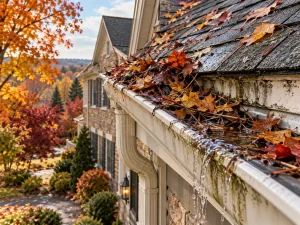
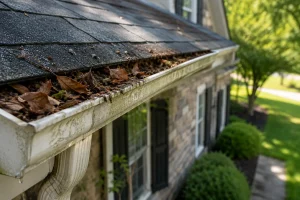
- Granules in gutters or at downspout exits — heavy fresh deposits after a storm signal hail damage
- Sagging gutters or downspouts pulled away from the house
Walk the full perimeter of your home. Damage on one slope doesn’t mean the other slopes are fine.
Step 4: Check Your Attic (First 3 Hours)
Your attic tells you what your roof won’t.
- Bring a flashlight and go up before the next rain
- Look for fresh moisture stains on decking or rafters
- Check insulation for wet spots or compression
- Look for daylight coming through where it didn’t before
- Watch for any musty smells that weren’t there yesterday
Even small amounts of moisture in the attic mean water is getting in. This is the most important indicator that you have damage requiring immediate attention.
Step 5: Check Your Interior (First 4 Hours)
Walk through every room in your home, including closets and the basement.
- Look at every ceiling for new stains, discoloration, or bubbling paint
- Check around windows and skylights for water intrusion
- Inspect walls in upper-floor rooms for moisture
- Listen for any dripping sounds
- Check the basement for new water — roof leaks can travel a long way before showing up
Anything new gets photographed and documented.
Step 6: Tarp or Cover Any Visible Damage (First 6 Hours)
If you’ve found visible damage that’s letting water in, you need to prevent further damage before the next rain.
- Do not climb on the roof yourself
- Call a professional roofer for emergency tarping (this is one of the services we provide)
- If you can safely cover an interior leak from inside (with buckets or plastic sheeting), do that to protect floors and furniture
- Move any valuable furniture or electronics away from active leaks
In our 16 years serving Bucks County, we’ve seen homeowners try to tarp their own roofs after storms and end up with falls, injuries, and even more damage. Don’t do it. Emergency tarping is a service we provide for Bucks County homeowners — call 215-696-1033 and we’ll come out fast.
Step 7: Call for a Professional Inspection (First 24 Hours)
This is the most important step on the list. Even if your roof looks fine from the ground, hidden damage is common — and it’s exactly the kind of damage that turns into a major problem if it goes unnoticed.
A professional inspection includes:
- Walking the roof and checking every slope and elevation
- Examining flashing around chimneys, vents, and skylights
- Checking ridge caps and ventilation
- Inspecting decking from the attic
- Photographing any damage found
Martin Roofing & Construction Inc. provides free storm damage inspections for Bucks County homeowners. Darin or Andy comes out personally — no salespeople, no pressure.
Step 8: Document Insurance Considerations (Within 48 Hours)
If you have homeowner’s insurance and you’ve found significant damage, contact your insurance company within 48 hours to understand your options. Note that we don’t handle insurance claim work directly — but we provide honest, detailed inspection reports that document what we found, which is exactly what most homeowners need for their own records.
Be careful of any contractor who shows up uninvited offering to “handle everything with insurance.” That’s a red flag in Bucks County and across the country.
What Hidden Damage to Watch For Over the Next Few Weeks
Even if your initial inspection looks clean, keep an eye on these warning signs in the days and weeks following any major storm:
- Ceiling stains that appear gradually
- New drafts or temperature changes in upper rooms
- Musty smells in the attic or upper floors
- Granules continuing to wash into gutters
- Shingles that weren’t curled before now lifting at the edges
Bucks County storms — especially hail and high-wind events — can cause damage that doesn’t fully reveal itself for weeks. If you notice any of these signs after a storm has passed, schedule an inspection right away.
Why You Should Call Martin Roofing & Construction Inc.
When you call MRC for a post-storm inspection, here’s what to expect:
- Personal on-site inspection — Darin or Andy walks your roof and checks your attic
- Full photo documentation — you get clear images of any damage found
- Honest assessment — if there’s no damage, we’ll tell you. If repairs are needed, we explain exactly what and why.
- Detailed estimate — no pressure, no upsell
- Fast turnaround — emergency tarping available, most inspections completed within 24–48 hours
If repair is needed, we handle it directly. If replacement is the smarter call, we explain why and lay out your options including flexible financing through Service Financing.
Why Bucks County Homeowners Choose Martin Roofing & Construction Inc.
We’ve been serving Bucks County homeowners since 2009 — Yardley, Newtown, Langhorne, New Hope, Doylestown, Warminster, Levittown, and every town in between. Here’s what makes MRC different:
- 16+ years serving Bucks County, PA — locally owned, family-run
- GAF Gold Elite Certified Contractor — top tier manufacturer certification
- Service-Disabled Veteran-Owned Small Business (SDVOSB) — VA verified
- Google Guaranteed — background checked and verified
- On-Site Project Manager on every job — Darin or Andy personally oversees your project
- 9 Google Rating — hundreds of Bucks County neighbors trust MRC
- 20-Year Workmanship Warranty + GAF Lifetime Manufacturer’s Warranty
- Financing available — flexible monthly payments through Service Financing
Frequently Asked Questions
Do you provide free storm damage inspections in Bucks County?
Yes. Martin Roofing & Construction Inc. provides free storm damage inspections for Bucks County homeowners. Call 215-696-1033 after any major storm event and we’ll come out to assess your roof — usually within 24–48 hours.
Do you offer emergency tarping after a storm?
Yes. If your roof has visible damage that’s letting water in, we provide emergency tarping services to prevent further damage before repairs or replacement. Call 215-696-1033 as soon as possible.
How much does roof repair cost in Bucks County, PA?
Most roof repairs in Bucks County range from $400 to $1,500 depending on the type and extent of the damage. Our average repair is around $1,000. We provide free, no-obligation estimates before any work begins.
How much does roof replacement cost in Bucks County, PA?
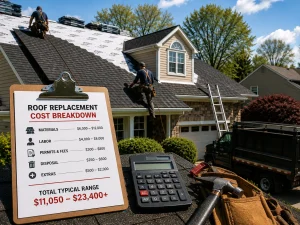
Most residential roof replacements in Bucks County range from $8,000 to $15,000 depending on the size of your home, roof pitch, and materials selected. Our average replacement is around $12,000.
How long does roof replacement take?
Most residential roof replacements in Bucks County are completed in a single day. We keep an on-site project manager on every job to ensure efficient, professional installation from start to finish.
Does Martin Roofing offer financing?
Yes. We offer flexible financing through Service Financing — easy application, fast approvals, and monthly payment options that fit your budget.
Should I climb on my roof to check for damage after a storm?
No. Wet shingles, hidden damage, and unstable footing make rooftop inspections dangerous for homeowners. Use binoculars from the ground for your initial check, then call a professional for a full inspection.
Is Martin Roofing & Construction licensed and insured in PA?
Yes. Martin Roofing & Construction Inc. holds PA License #PA116467 and is fully insured throughout the Tri-State Area. We are also Google Guaranteed and GAF Gold Elite Certified.
Next Steps
If a severe storm just hit your area in Bucks County, here’s what to do right now:
- Confirm the area is safe — no downed lines, unstable debris, or structural concerns
- Document everything with photos — before you touch anything
- Inspect from the ground — never climb on your roof
- Check your attic and interior — look for moisture, stains, or daylight
- Schedule a free professional inspection — within 24–48 hours
- Document for your records — keep clear photos and notes
Call 215-696-1033 or request your free storm damage inspection at mrc-roofing.com. We respond promptly and serve all of Bucks County and surrounding areas. Hours: 7:00 AM – 7:00 PM, seven days a week. Free, no-obligation inspection — guaranteed.
About the Author
Darin Martin is the Owner & President of Martin Roofing & Construction Inc. With 16+ years of hands-on roofing experience in Bucks County, PA, Darin has personally overseen hundreds of residential and commercial roofing projects throughout Yardley, Newtown, Langhorne, and the surrounding areas. As a GAF Gold Elite Certified contractor and Service-Disabled Veteran, Darin brings professional-grade expertise and military-level accountability to every job.